

Stay updated with our factory’s latest R&D innovations, manufacturing updates, and maintenance guides.
Aug. 07, 2026
In the power tool industry, a common question arises: why do 60‑joule heavy‑duty rotary hammers lack the conventional safety switch found on standard‑duty models? Is this merely a cost‑cutting measure that prioritizes profit over safety?
The reality, however, is quite the opposite. What appears to be an omission is in fact a major upgrade in safety philosophy – a shift from basic accidental‑start prevention to active risk mitigation and on‑site adaptability, features specifically engineered for high‑demand professional applications. This is a considered, precise response to real‑world industrial needs – not a concession that lowers safety standards.
The Limitation of Traditional Safety Switches
Traditional safety switches work by mechanically locking the trigger to prevent the tool from starting when not intentionally operated. At their core, they're a passive, entry-level safety measure designed for low-to-medium power hammer drills used in light-duty scenarios — mainly to prevent accidental button presses during casual use.
But 60-joule heavy-duty rotary hammers are built for professional industrial environments. They operate in more complex conditions, deliver far greater impact force, and face more hidden safety risks. A basic mechanical switch simply can't keep up. That's why the entire safety design logic shifts at this power level — and here's how it breaks down.
1. From "Passive Anti-Mistouch" to "Active Risk Protection"
A standard safety switch only solves one basic problem: preventing the tool from turning on if someone bumps the trigger. It does nothing to handle the sudden, high-risk situations that heavy-duty tools encounter during intense work.
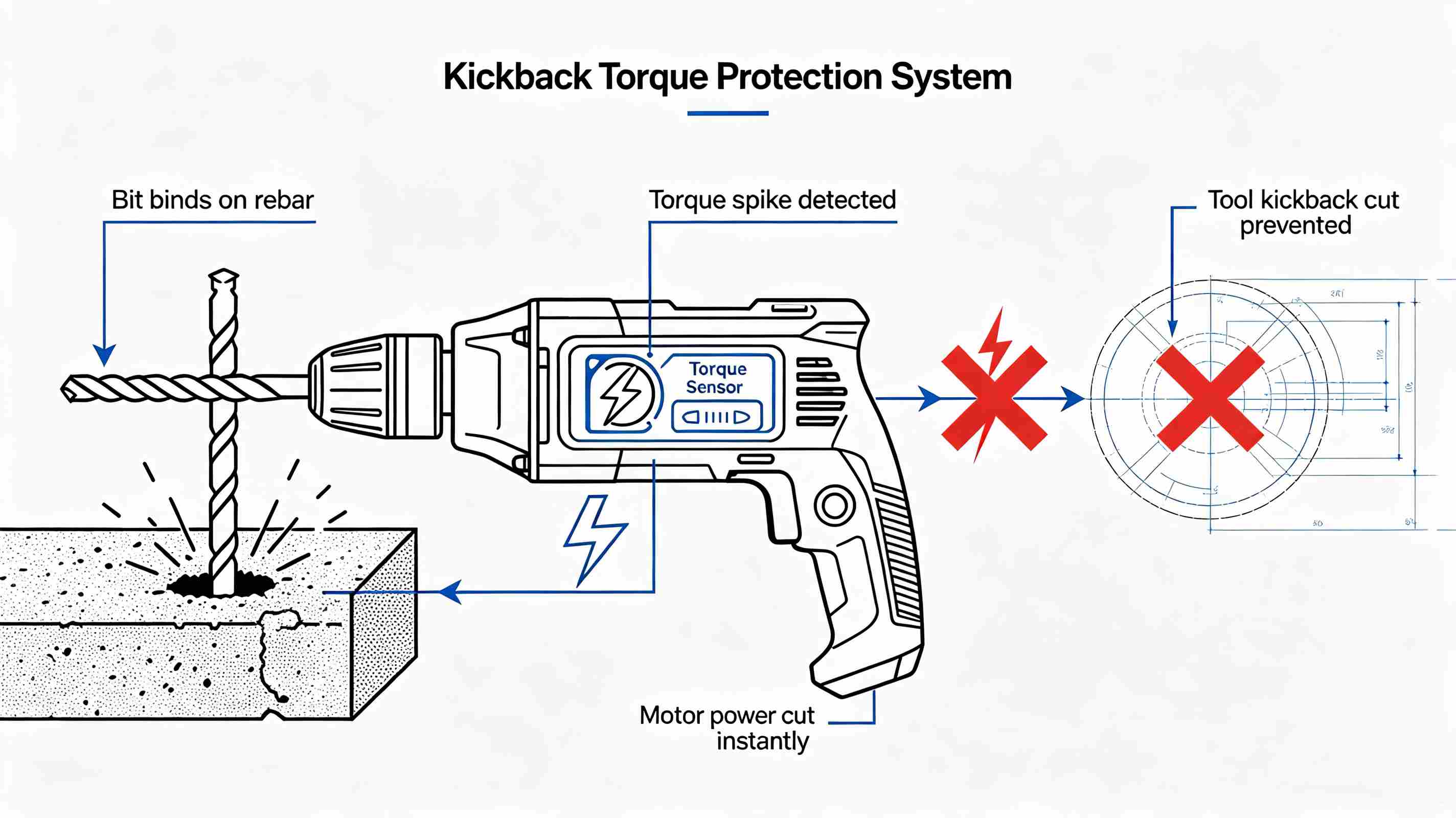
60-joule class rotary hammers, by contrast, are equipped with intelligent active safety systems—most notably, torque protection technology similar to Bosch's "KickBack Control."
Here's how it works: during chiseling, demolition, or other high-impact operations, if the bit suddenly binds on rebar or hard material, the tool's torque spikes instantly.The active safety system responds in milliseconds , cutting power to the motor directly at the source.This prevents the tool from violently twisting out of the operator's hands — a leading cause of wrist injuries and lost control on job sites.
This kind of targeted, high-risk protection is far more relevant to heavy-duty tools than a simple anti-mistouch switch.
2. The Nature of Heavy-Duty Work Makes Traditional Switches Counterproductive
The primary function of a 60-joule rotary hammer is heavy hammering and chiseling — jobs that require sustained, powerful impact over long periods. The operator needs to hold the tool steadily and keep it running continuously.
If you forced a traditional safety switch onto this kind of tool, the operator would have to maintain constant pressure on the trigger the entire time. That creates two big problems:
Hand fatigue skyrockets during long chiseling sessions.
Unstable grip from fatigue causes the tool to shake, reducing work precision.
Worse, if the operator's hand slips slightly mid-job and the safety switch disengages, the tool would suddenly stop — and that abrupt halt of a massive impact force can actually be more dangerous than letting it run.
That's why high-end heavy-duty hammers use a mode-linked safety design :
In rotary drilling mode , a mechanical lock automatically engages the switch to prevent accidental starts.
In hammer-only or chiseling mode , the switch can be locked in the "on" position for continuous operation.
This isn't removing safety — it's making safety fit the job .
A 60-joule rotary hammer isn't designed for casual home users. It's built for construction, mining, road work, and other heavy industrial applications. The people using it are trained professionals who know how to handle the tool properly — two-handed grip, proper stance, familiarity with safety procedures. Accidental trigger presses are extremely rare in this user group.
So the design focus moves past the beginner-level "mistouch switch" and toward advanced protections that actually matter in professional settings:
- Restart protection : Prevents the tool from suddenly turning back on after a power outage — a critical safety feature on busy job sites
- Electronic constant speed : Maintains stable RPM under varying loads, preventing the tool from bogging down or surging unexpectedly
- Vibration damping systems : Reduce long-term operator fatigue and injury risk
These advanced features address the real safety hazards of professional work — not the hypothetical ones.
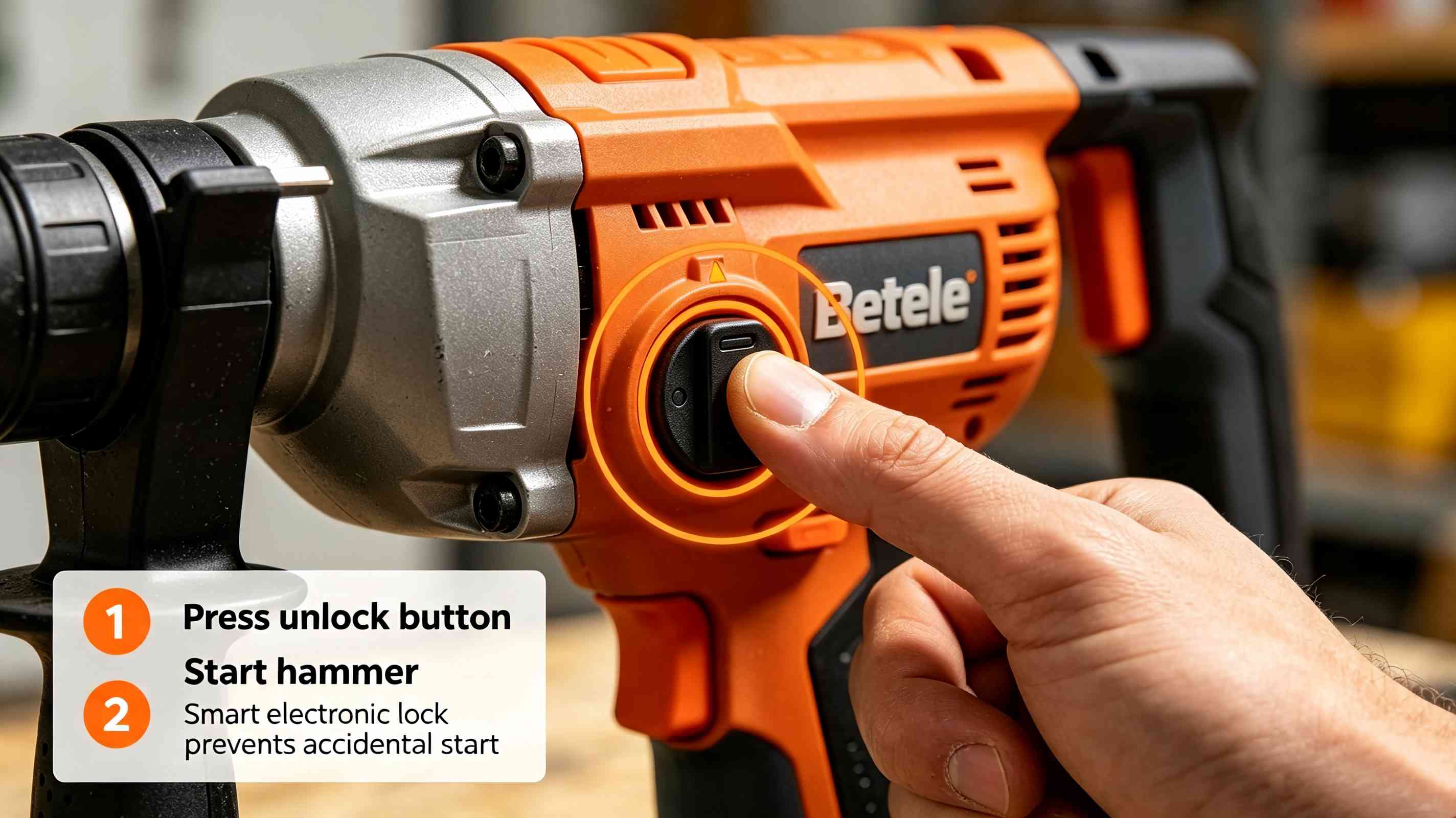
As power tool technology advances, safety design is moving beyond old-fashioned mechanical locks toward smarter, more precise electronic control . The electronic safety lock found on 60-joule rotary hammers is a perfect example of this evolution.
Before the tool can start, the operator must complete a specific "unlock" sequence using designated buttons. This prevents accidental starts at the source — just like a mechanical switch — but with the speed and precision of electronic control. No more slow, clunky mechanical triggers that can stick or wear out.
It's the best of both worlds: the mistouch prevention of a traditional safety switch, plus the responsiveness and precision of modern electronics.
Overview
Removing the traditional safety switch from a 60-joule heavy-duty rotary hammer is not cutting corners or ignoring safety. It's a deliberate, engineering-driven choice based on real professional use cases and technological advancement.
These tools replace the basic mechanical switch with something far better:
Intelligent active protection that responds to real job-site dangers.
Mode-specific safety design that doesn't interfere with actual work.
Professional-grade features tailored to trained operators.
Electronic smart locking that's faster and more reliable than old mechanical systems.
The result is a comprehensive upgrade in safety performance — not a downgrade.
What This Means for Users
If you're using a high-end rotary hammer, don’t worry about the absence of a traditional safety switch. Pay attention to understanding the tool's intelligent safety systems and following proper operating procedures — two-handed grip, correct stance, and adherence to safety guidelines.
When you know how the protection works and use the tool as intended, you will get the full benefit of its advanced safety design.
Related News


