

Stay updated with our factory’s latest R&D innovations, manufacturing updates, and maintenance guides.
Aug. 19, 2026
Betele Technical Insights | Published: August 18, 2026
By Betele Power Tools Engineering Team
EMC testing is an important part of cordless power tool development. When a rotary hammer or other high-power tool fails an EMC test, adding magnetic rings is not always the best solution. This article explains the main causes of EMC problems and practical ways to improve power tool EMC performance.
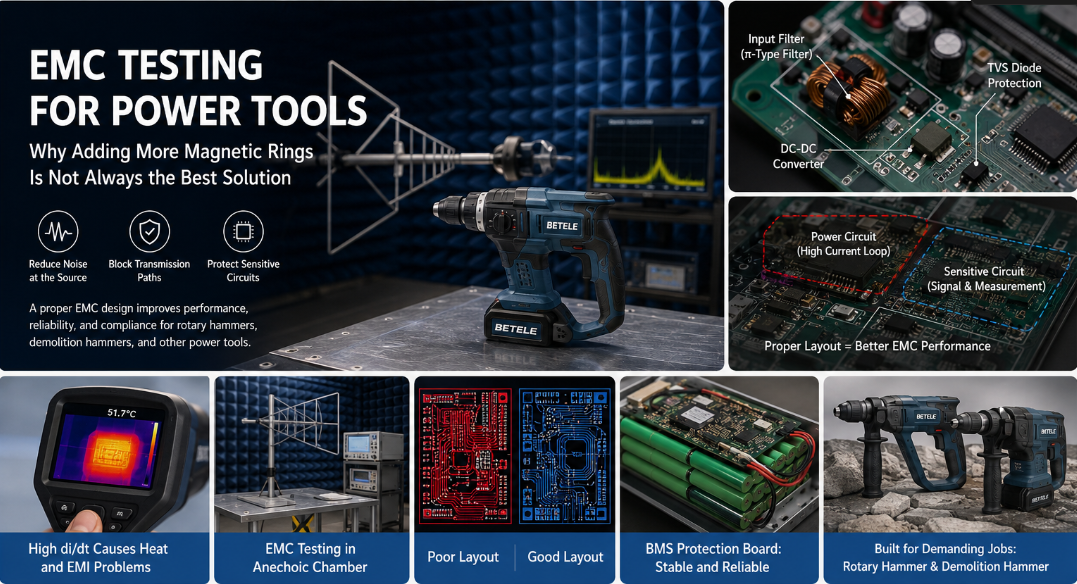
Modern cordless power tools use high-speed electronic circuits to control motors, batteries, and protection systems. A cordless rotary hammer may contain a brushless DC motor, MOSFET power switches, a motor controller, a battery pack, a BMS, a DC-DC converter, sensors, a microcontroller, and communication circuits.
These components can create high-frequency electrical noise during operation.
MOSFETs can switch current very quickly. A fast change in current, or high di/dt, can create high-frequency noise. This noise may travel through power lines or appear as radiated electromagnetic energy.
DC-DC converters also use high-frequency switching. If the circuit layout and filtering are not well designed, switching noise can enter other parts of the system.
The motor is another important source of electrical noise. During operation, especially under heavy loads, the motor and switching devices can create strong electromagnetic interference. For rotary hammers and demolition hammers, this can be more noticeable because the motor may operate under high current and changing loads.
Long wires, large current loops, poor grounding, and incorrect component placement can increase EMC problems. This is why EMC should be considered from the beginning of product development.
A useful way to understand EMC problems is to look at three basic elements:
Noise Source → Coupling Path → Sensitive Circuit
If engineers can control one or more of these three elements, the EMC problem can often be reduced.
The first step is to reduce interference at its source. Engineers can optimize MOSFET switching speed, gate drive circuits, snubber circuits, motor control parameters, switching frequency, and PCB current loops.
An RC snubber circuit can sometimes reduce voltage spikes and ringing caused by fast switching. However, component values should be selected based on measurements rather than simply adding parts.
If the noise source cannot be completely removed, the next step is to control the transmission path. Depending on the circuit, engineers may use capacitors, inductors, common-mode chokes, LC filters, π-type filters, ferrite beads, or TVS protection devices.
A properly designed input filter can reduce high-frequency noise traveling through a power supply line. The filter should match the frequency range, current level, impedance, and electrical characteristics of the system.
Sensitive circuits such as voltage, temperature, current-sensing, and communication circuits should be separated from high-power switching areas when possible. Good grounding, signal routing, and physical separation can reduce the effect of electromagnetic noise.
Magnetic rings and ferrite components are common tools for EMC improvement. They can be useful for reducing certain types of high-frequency noise on cables and power lines.
However, more magnetic rings do not always mean better EMC performance. If the interference comes from a poor PCB layout or a large high-frequency current loop, adding a magnetic ring may only reduce the symptom instead of removing the original source.
For example:
Poor PCB layout → strong high-frequency noise → cable radiation → EMC failure
A better engineering approach may be:
Improve PCB layout → reduce current loop area → reduce noise at the source
This approach can provide a more stable solution and may also reduce unnecessary component cost.
Good PCB layout is one of the most important parts of EMC design. A large high-frequency current loop can act like an antenna and increase electromagnetic radiation.
High-power circuits should be separated from sensitive signal and measurement circuits when possible. For example, battery voltage and temperature sensing circuits should be protected from strong switching noise.
For cordless power tools, the battery management system (BMS) is also important. A BMS normally monitors and protects the battery by managing battery voltage, cell voltage, temperature, over-current protection, over-voltage protection, short-circuit protection, and battery communication.
The BMS must continue to work correctly even when the power tool is producing strong electrical noise.
Therefore, BMS EMC design should not be treated as a final-stage fix. It should be considered during schematic and PCB design.
EMC performance is not the only challenge for power tools. Rotary hammers and demolition hammers can experience strong vibration, repeated impact, high motor current, temperature changes, dust, and long working hours.
Electronic components, connectors, and wiring therefore need to be designed for both electrical and mechanical reliability.
A solution that works in a laboratory may not perform the same way after long-term vibration and impact. Power tool development should consider EMC, electrical safety, thermal performance, and mechanical reliability as one complete system.
Typical sources include MOSFETs, motor controllers, DC-DC converters, motors, and switching power supplies.
Look for large high-frequency current loops on the PCB and reduce the loop area whenever possible.
Poor grounding can create unexpected noise paths. The grounding structure should match the circuit design and current flow.
Do not add magnetic rings, capacitors, or filters simply because an EMC test failed. First identify the frequency and transmission path of the noise, then select the correct component.
Testing should consider realistic conditions such as no-load operation, heavy load, motor starting, sudden load changes, and long working periods.
A useful development process is:
Design → Prototype → Pre-test → Identify Noise Source → Improve Design → Retest → Certification
This is generally more effective than repeatedly adding random filters after a failed test. The goal is to find the root cause and create a stable solution.
A professional manufacturer should be able to explain not only product specifications, but also how the product is designed, tested, and improved.
For professional power tools, reliability is just as important as power. A rotary hammer or demolition hammer may work at high power for long periods, creating high electrical current, motor switching noise, heat, and mechanical vibration.
Good EMC design can help improve product stability, communication reliability, electronic protection, user safety, and long-term durability.
For B2B customers, these factors can be especially important when purchasing power tools for distributors, construction companies, and professional users.
EMC testing checks whether a power tool creates too much electromagnetic interference and whether it can work correctly in its electromagnetic environment.
Common causes include motor switching, MOSFET switching, DC-DC converters, PCB layout, cables, grounding, and high-frequency current loops.
No. Magnetic rings can reduce certain types of high-frequency noise, but they cannot solve every EMC problem. The real noise source and transmission path should be identified first.
The BMS monitors and protects the battery. Good BMS EMC design helps prevent communication errors, false protection, and unstable operation caused by electromagnetic interference.
Poor PCB layout can create large high-frequency current loops and unwanted noise paths. A good layout can reduce electromagnetic noise before additional filters are needed.
Betele is a professional manufacturer of rotary hammers and demolition hammers, serving professional and industrial power tool markets. Our product development focuses on power, durability, reliability, and long-term working performance.
For distributors, importers, and professional tool companies, Betele provides rotary hammers, demolition hammers, and other power tool solutions.
Learn more about Betele rotary hammers, demolition hammers, and cordless power tools through our product categories and technical resources.
Betele Power Tools | Technical Insights
Related News


