

Stay updated with our factory’s latest R&D innovations, manufacturing updates, and maintenance guides.
Aug. 21, 2026
When choosing an electric demolition hammer, power is one of the most important specifications to consider. However, a higher wattage does not always mean a better tool.
The right demolition hammer power depends on the type of material, working conditions, job length, and the level of breaking performance you need.
Choosing the right power can help you work more efficiently while reducing unnecessary weight, energy use, and operator fatigue.
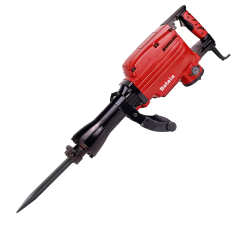
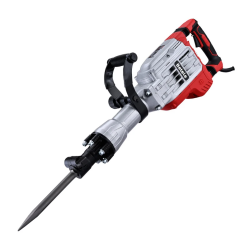
Demolition hammer power is usually measured in watts (W). It shows how much electrical power the tool uses during operation.
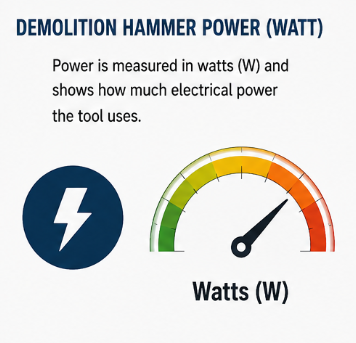
For example, a 1,500W demolition hammer generally uses more electrical power than a 1,000W model.
However, wattage is not the only factor that determines breaking performance. Other specifications are also important, such as:
This means that two demolition hammers with similar wattage may not have exactly the same performance.
A higher-power demolition hammer can provide strong performance for demanding jobs.
It is often suitable for breaking hard materials such as:
For heavy-duty demolition work, a powerful tool can help remove material faster and reduce the time needed for each job.
However, the actual breaking performance also depends on the tool’s impact energy. Therefore, buyers should look at both wattage and impact energy when comparing demolition hammers.
A more powerful demolition hammer is often larger and heavier.
This can be useful for heavy-duty applications because a heavier tool can provide strong breaking performance. However, it can also make the tool more difficult to handle for long periods.
For example, a worker doing overhead or continuous demolition may prefer a lighter model, even if it has lower power.
Therefore, the best demolition hammer is not always the most powerful one. It should provide the right balance between power, impact energy, weight, and comfort.
A higher-wattage demolition hammer normally consumes more electrical power when operating.
For jobs that require several hours of continuous work, energy consumption can become an important factor.
If the application does not require very high breaking power, choosing a suitable lower-power model may help reduce unnecessary energy use.
For professional users, it is useful to consider both the purchase price and the long-term operating cost.
It is common to think that a more powerful demolition hammer will always be much louder. In reality, noise levels depend on many factors.
These include:
Therefore, users should check the manufacturer’s noise and vibration specifications when available instead of judging the tool only by its wattage.
The right power depends mainly on your application.
For smaller repair and renovation jobs, a lower-power demolition hammer may be enough.
Typical applications include:
A lighter tool can be easier to control and more comfortable for occasional use.
For general construction and renovation work, a medium-power demolition hammer can provide a good balance between performance and handling.
It can be suitable for:
This type of tool is often a good choice for contractors who need a versatile machine for different jobs.
For demanding construction, mining, and demolition work, a heavy-duty demolition hammer with higher power and strong impact energy may be more suitable.
Typical applications include:
For these applications, strong impact energy and durability are often more important than keeping the tool as light as possible.
When comparing demolition hammers, do not look at wattage alone.
Power describes the electrical energy used by the motor, while impact energy describes the force delivered by the hammer mechanism with each impact.
A simple way to understand the difference is:
Power = motor input
Impact energy = breaking force delivered to the material
For demolition work, impact energy is especially important because it directly relates to the tool’s ability to break hard materials.
Therefore, when selecting a demolition hammer, it is better to compare several specifications together rather than choosing a model based only on wattage.
Power is important, but it is not the only specification that matters.
If the tool will be used for many hours, weight can have a major effect on operator fatigue.
Impact rate is normally measured in BPM (blows per minute). It shows how many impacts the tool can make in one minute.
Impact energy is usually measured in joules (J). A higher impact energy can provide stronger breaking performance.
Different demolition hammers may use different tool holders, such as HEX or SDS systems. Make sure the chisel and accessories are compatible with the machine.
Consider where and how the tool will be used. Construction sites, renovation projects, mining areas, and road work may require different levels of power and durability.
No.
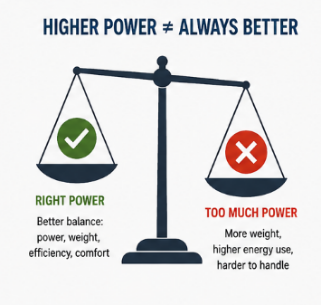
A high-power demolition hammer can be an excellent choice for heavy-duty work, but it may be unnecessary for light applications.
Using a tool that is too powerful can increase weight, energy consumption, and handling difficulty without providing much additional value.
The best choice is a demolition hammer that matches the material, workload, working time, and job requirements.
Demolition hammer power has a direct effect on tool performance and energy consumption, but wattage should not be the only factor when choosing a machine.
For light renovation work, a compact and lightweight model may be more comfortable. For general construction, a medium-power model can provide a good balance between performance and handling. For heavy-duty demolition and hard materials, a high-power model with strong impact energy may be the better choice.
Before buying an electric demolition hammer, compare power, impact energy, impact rate, weight, tool holder, and working conditions.
Choosing the right combination of specifications can help you get better performance, improve working efficiency, and reduce unnecessary operating costs.
Related News


