

Stay updated with our factory’s latest R&D innovations, manufacturing updates, and maintenance guides.
Aug. 27, 2026
By Betele Power Tools Management Team-Emma
When comparing rotary hammers, buyers often see specifications such as RPM, BPM, impact energy, and motor power.
BPM means Blows Per Minute.
It describes how many impact cycles the hammer mechanism produces within one minute under the specified operating conditions.
But a higher BPM does not automatically mean a better rotary hammer.
From a technical perspective, BPM needs to be considered together with impact energy, rotation speed, material, accessory type, and the intended application.
Understanding this relationship can help users compare rotary hammer specifications more effectively.
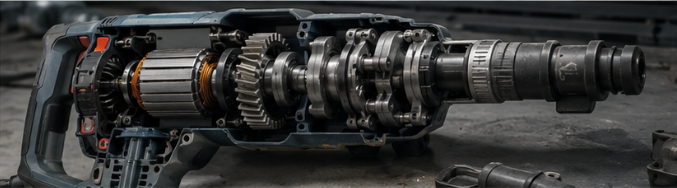
BPM stands for:
Blows Per Minute
It describes the frequency of the hammering action.
In simplified terms:
BPM = How frequently the tool delivers impacts.
For example, a rotary hammer rated at a higher BPM produces more impact cycles per minute than a tool with a lower BPM, assuming the specifications are measured under comparable conditions.
However, BPM does not tell you how much energy each individual impact contains.
That is where impact energy becomes important.
These two specifications are related, but they describe different characteristics.
Impact energy describes the energy delivered during an individual impact.
In simple terms:
Impact energy = strength of each strike
BPM describes how frequently those impacts occur.
In simple terms:
BPM = number of strikes over time
This means:
This is why comparing two rotary hammers only by BPM can be misleading.
A tool with a very high BPM but relatively low impact energy may behave differently from a tool with stronger individual impacts and a different impact frequency.
No.
This is probably the most important point when reading rotary hammer specifications.
A higher BPM can be useful for certain applications, but it is not a universal measure of tool quality.
The ideal impact frequency depends on the mechanical design and intended application.
For example, a rotary hammer designed for general concrete drilling may have different performance characteristics from a heavy-duty tool designed for demanding chiseling.
The manufacturer needs to balance:
Therefore, BPM should be interpreted as part of a system rather than as a standalone ranking number.
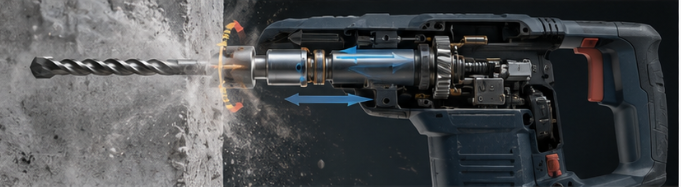
Another specification commonly found on rotary hammers is RPM — Revolutions Per Minute.
RPM describes rotational speed.
BPM describes impact frequency.
The two functions serve different purposes.
Supports the rotation of the drill bit.
Supports the repeated impact action.
During hammer drilling, both actions work together.
The bit rotates while the hammer mechanism delivers repeated impacts.
This combined action allows the tool to penetrate hard materials more effectively than rotation alone.
However, the ideal relationship between RPM and BPM depends on the tool design and application.
This is why simply choosing the highest RPM and highest BPM is not necessarily the correct approach.
The required BPM depends partly on what the tool is being used for.
The tool needs a suitable combination of impact energy, BPM, and RPM to penetrate the material efficiently.
A balanced impact frequency can support repeated drilling while maintaining control.
Rotation may be disabled while the impact mechanism continues operating.
In this situation, impact energy and impact frequency become particularly relevant.
The tool may need enough impact performance to remove material while remaining manageable for the operator.
These examples show why specifications need to be connected to actual working conditions.
A rotary hammer is an integrated mechanical system.
If one parameter is increased without considering the rest of the system, overall performance does not necessarily improve.
For example, increasing impact frequency can increase the number of mechanical cycles the internal components experience.
That means the design may need to account for:
Similarly, increasing impact energy can increase the mechanical loads transferred through the hammer mechanism and accessory.
This is one reason professional manufacturers cannot evaluate performance based on a single specification.
The entire system needs to be designed around the intended workload.
When comparing two models, create a simple specification checklist.
What will the tool actually be used for?
Look at the manufacturer's recommended drilling diameter and working range.
Consider the energy delivered by each impact.
Look at impact frequency together with impact energy.
Consider the rotational speed for drilling applications.
A powerful tool that is difficult to control may not be the best choice for every working position.
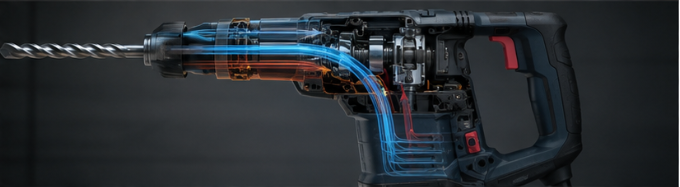
For professional users, cooling, vibration control, mechanical components, and maintenance requirements are also important.
This method provides a more complete picture than comparing BPM alone.
One practical issue for buyers is that specifications from different manufacturers may not always be directly comparable.
BPM can be influenced by:
Therefore, buyers should check the manufacturer's published test conditions when available.
For distributors and purchasing managers, it is also useful to ask:
Is the BPM value measured under no-load conditions?
What operating mode does the specification refer to?
What impact energy is associated with the stated BPM?
What is the recommended application range?
These questions can provide more useful information than simply comparing the largest number on two specification sheets.
Imagine two rotary hammers.
Which one is better?
There is no universal answer.
If the application requires frequent lighter impacts, Tool A may have characteristics that suit the task.
If the application involves harder material and requires stronger individual impacts, Tool B may be more appropriate.
But the final decision should also consider:
This is why professional tool selection is about matching specifications to the job, not simply finding the biggest number.
For distributors, contractors, and purchasing managers, a more complete specification review should include:
How much energy is delivered by each impact?
How frequently does the impact mechanism operate?
How quickly does the tool rotate?
What hole sizes is the tool designed to handle?
Can it drill, hammer drill, and chisel?
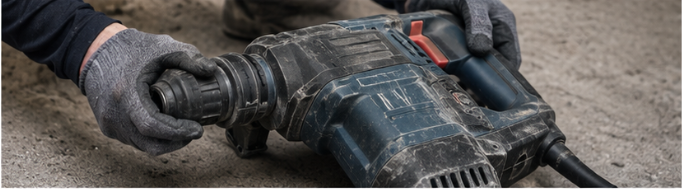
Which accessory system is supported?
Is the tool suitable for the intended working position?
Can the tool handle the expected workload?
This approach helps buyers understand what the tool is designed to do rather than judging it by one specification.
From a manufacturing perspective, rotary hammer specifications cannot be evaluated independently.
When developing a professional tool, parameters such as BPM, impact energy, RPM, motor output, tool weight, and mechanical durability need to be considered as parts of the same system.
At Betele, our rotary hammer development and manufacturing experience includes dedicated motor and gearbox production, assembly, and quality control. This allows different components of the tool to be considered together rather than treating individual specifications as isolated numbers.
For buyers, this is an important distinction.
A higher BPM figure may look attractive on a specification sheet, but the more useful question is whether the complete tool is properly matched to the intended application.
For distributors, wholesalers, and private-label brands, evaluating the manufacturer behind the specifications can therefore be just as important as comparing the specifications themselves.
BPM is an important rotary hammer specification because it describes the frequency of the impact mechanism.
But BPM does not measure impact strength by itself.
To understand the actual performance of a rotary hammer, users should consider:
BPM + Impact Energy + RPM + Drilling Capacity + Application + Tool Design
The most suitable tool is not necessarily the one with the highest BPM.
It is the tool whose impact frequency, impact energy, rotation speed, mechanical design, and physical configuration are appropriately matched to the intended application.
For professional users, this way of reading specifications can make product comparison more practical and help avoid selecting a tool based on a single number.
At Betele, we believe that useful power-tool information should start with the working conditions and the technical requirements of the user, rather than with a single specification.
The right question is not simply “Which rotary hammer has the highest BPM?” but “Which combination of performance characteristics is right for the job?”
Related News


