

Stay updated with our factory’s latest R&D innovations, manufacturing updates, and maintenance guides.
Aug. 18, 2026
Category: Product & Tech
Breaking concrete, stone, and other hard materials is not simply a matter of choosing the highest-powered demolition hammer. For professional users, the real question is how effectively the tool converts motor power into repeated impact energy at the working surface.
Impact energy, measured in Joules (J), is one of the most important specifications to consider when evaluating a demolition hammer. Understanding what it means—and how it works together with impact frequency, internal components, and application conditions—can help users choose a tool that delivers consistent performance.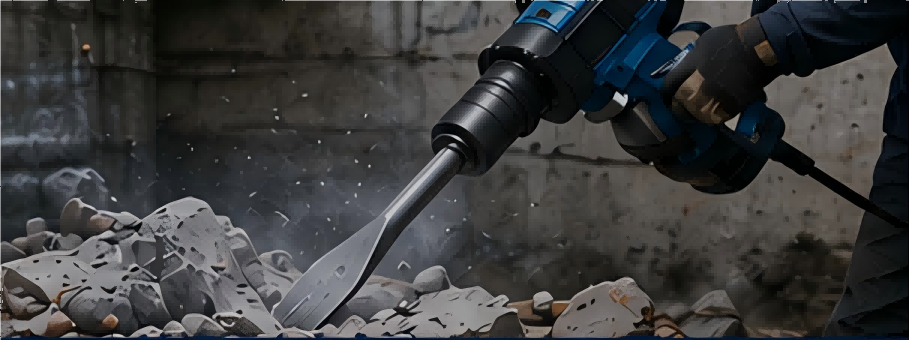
Impact energy refers to the amount of energy delivered by the hammer mechanism during each individual impact.
In simple terms:
Higher impact energy means a stronger strike per impact.
This is particularly important when working with hard materials such as:
However, impact energy should not be considered independently. A tool with high impact energy still needs a reliable internal mechanism and effective energy transfer system to convert that energy into useful breaking performance.
This is why professional demolition hammer selection should look beyond a single number.
When breaking hard materials, each impact creates stress inside the material. If the impact is strong enough, cracks can develop and spread through the concrete or stone.
A higher-energy impact can help the tool remove more material with each strike, particularly in demanding applications.
This can be useful for:
However, stronger does not always mean better for every job.
Using a tool with excessive impact energy for a relatively light application can increase operator fatigue and place unnecessary stress on the tool and accessory.
The best choice is therefore the appropriate impact energy for the material and workload.
A professional demolition hammer is a complete mechanical system.
Its performance depends on the interaction between:
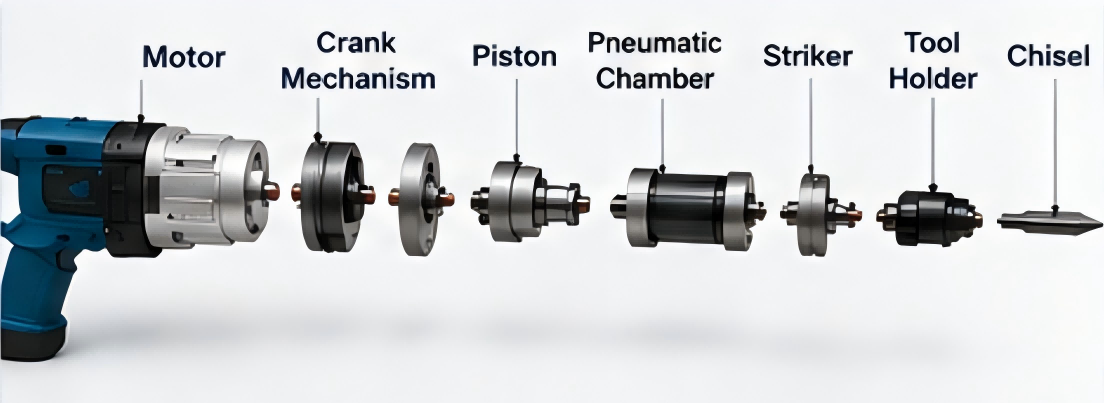
The motor generates mechanical power, while the hammer mechanism converts that movement into repeated impacts.
The final result depends on how efficiently energy moves through the entire system.
This means two tools with similar rated power may not necessarily deliver the same working experience.
For manufacturers, mechanical design, component strength, lubrication, heat management, and manufacturing precision all contribute to long-term performance.
Another important specification is BPM, or blows per minute.
Impact energy describes the energy delivered by each impact, while BPM describes how frequently those impacts occur.
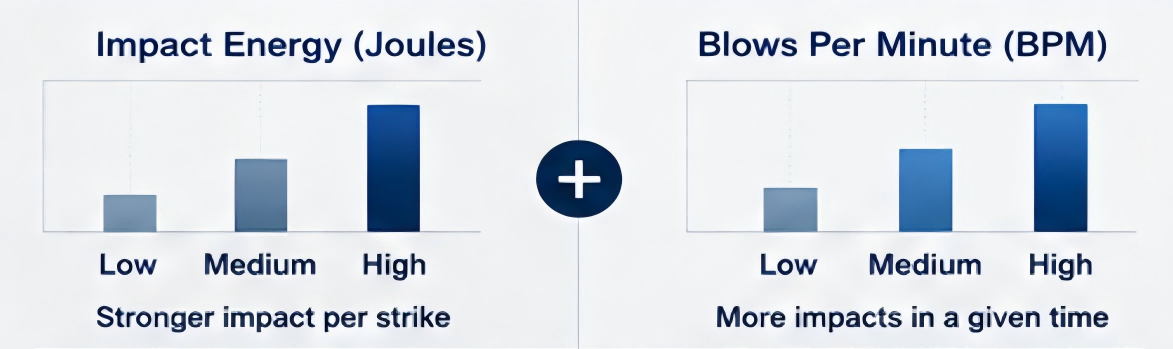
In simplified terms:
For heavy demolition, a powerful individual impact can be particularly important when breaking dense concrete or hard stone.
For other applications, impact frequency can also contribute significantly to material removal.
Therefore, professional users should evaluate impact energy and BPM together, rather than selecting a tool based on either specification alone.
The ideal impact energy depends heavily on the working environment.
For example:
Light renovation
A smaller demolition hammer may provide sufficient performance while remaining easier to control.
Concrete demolition
Higher impact energy can become more important when breaking thick or reinforced concrete.
Hard stone
The tool needs sufficient impact energy combined with durable internal components and suitable chisels.
Continuous heavy-duty work
Long-term reliability, cooling performance, vibration control, and component durability become just as important as impact energy.
This is why professional tool selection should always start with the actual application rather than the specification sheet alone.
Impact energy is one of the clearest indicators of demolition hammer capability, but it should never be the only factor.
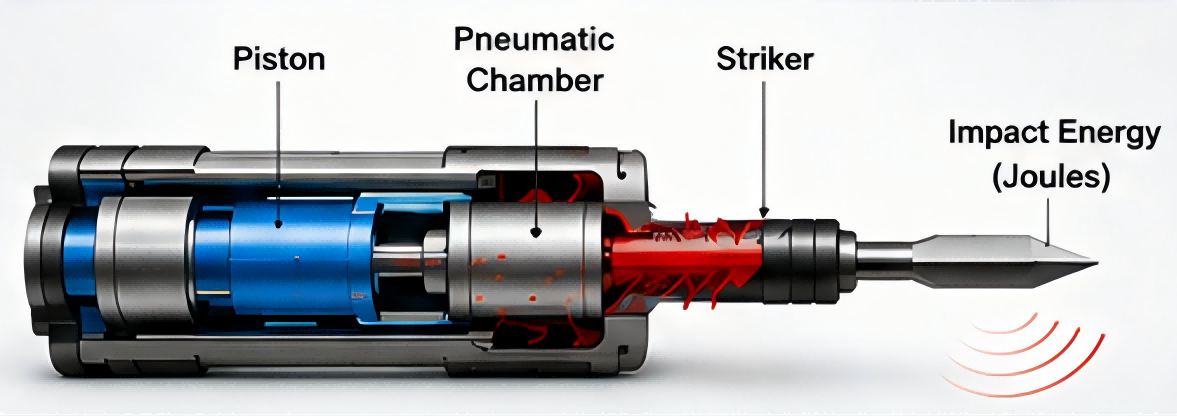
When selecting a professional demolition hammer, consider:
From a manufacturing perspective, the goal is not simply to make the strongest possible impact. The goal is to create a balanced system that delivers reliable impact performance over the intended working life of the tool.
For professional users, that balance can mean better productivity, more predictable performance, and lower downtime.
Impact energy matters because it directly influences how strongly a demolition hammer strikes the material. But the best professional tool is not necessarily the one with the highest Joule rating.
The most useful way to evaluate a demolition hammer is to consider impact energy, impact frequency, mechanical design, durability, and application requirements together.
When these factors are properly matched, a demolition hammer can deliver more consistent performance in demanding concrete, stone, and construction applications.
Related News


